Reading of the Will El Torino Movie
| Gran Torino | |
|---|---|
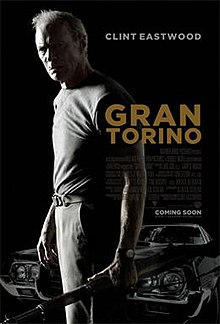 Theatrical release poster | |
| Directed by | Clint Eastwood |
| Screenplay by | Nick Schenk |
| Story by |
|
| Produced by |
|
| Starring | Clint Eastwood |
| Cinematography | Tom Stern |
| Edited by |
|
| Music by |
|
| Production |
|
| Distributed by | Warner Bros. Pictures |
| Release date |
|
| Running time | 116 minutes[ane] |
| Country | Us |
| Language | English language |
| Budget | $25–33 million[2] [3] |
| Box office | $270 meg[three] |
Gran Torino is a 2008 American drama moving picture directed and produced by Clint Eastwood, who also starred in the film. The film co-stars Christopher Carley, Bee Vang, and Ahney Her. This was Eastwood's first starring role since 2004'southward Million Dollar Baby. The film features a large Hmong American bandage, equally well equally i of Eastwood's younger sons, Scott. Eastwood'due south oldest son, Kyle, provided the score. Set up in Highland Park, Michigan, it is the first mainstream American film to feature Hmong Americans. Many Lao Hmong war refugees resettled in the U.South. following the establishment of a socialist government in Laos in 1975.[4]
The story follows Walt Kowalski, a recently widowed Korean War veteran alienated from his family and angry at the world. Walt's young neighbour, Thao Vang Lor, is pressured by his cousin into trying to steal Walt's prized 1972 Ford Torino for his initiation into a gang. Walt thwarts the theft and later on develops a relationship with the boy and his family.
Gran Torino opened in a limited theatrical release in the United States on December 12, 2008, before expanding wide on January 9, 2009.[five] It grossed $270 one thousand thousand worldwide, making information technology Eastwood's 2nd highest-grossing picture show to-date.[6] The flick received positive reviews from critics for Eastwood's direction and performance; within the Hmong customs in the U.s., the moving-picture show was generally praised only also received criticism for its cultural inaccuracies.
Plot [edit]
Cantankerous, narrow-minded Korean War veteran and retired Ford manufactory worker Walt Kowalski is widowed after 50 years of marriage. His crumbling neighborhood in Highland Park in Metro Detroit was formerly populated by working-class white families merely has get filled with gang violence and poor southeast Asian immigrants, including Walt's next-door neighbors, the Vang Lor family. Calculation to his isolation, Walt is emotionally detached from his family unit; he rejects his son's suggestion he move to a retirement customs and lives alone with his elderly Labrador, Daisy. A chronic tobacco user, Walt suffers from cough fits, occasionally with claret, which he conceals from his family. Walt's belatedly wife's priest, Father Janovich, tries to comfort Walt, who dismisses him every bit young and inexperienced.
Walt catches Thao Vang Lor attempting to steal his Ford Torino as a coerced initiation into a Hmong gang run by Thao's cousin, "Spider." Even after this failed attempt the gang yet wants to take Thao with them, but Walt drives them off with his M1 Garand, earning the Hmong community'due south respect. Equally penance, Thao'southward female parent makes him work for Walt, who has him do different jobs in the neighborhood. The ii soon class a grudging mutual respect, and Walt mentors Thao, helping him obtain a construction job and giving him social and dating advice. Walt rescues Thao's sister, Sue, from the unwanted advances of three rough youth and bonds with her too. Walt consults his md, who gives him a gloomy prognosis that he conceals from his family.
Spider's gang continues to pressure Thao and assaults him on his way dwelling house from work. Walt visits the gang'due south business firm and attacks a member as a warning. In retaliation, the gang rapes Sue and injures Thao in a drive-by shooting. The members of the community, including Thao and Sue, refuse to study the crimes out of fearfulness. The following mean solar day, an enraged Thao seeks Walt's aid to exact revenge; Walt tells him to render later on that day. Walt makes personal preparations: He mows his backyard, buys a suit, gets a haircut and makes his confession to Begetter Janovich.
Walt takes Thao to his basement and gives him his Silverish Star, so tells him that he is still haunted past the memory of killing an enemy soldier who was fix to surrender and that he wants to spare Thao from becoming a killer. He locks Thao in the basement and heads to the gang's residence. The gang members betoken their guns at Walt, who loudly berates them for their crimes, cartoon the attention of the neighbors. Walt puts a cigarette in his mouth, reaches into his jacket pocket and pulls his hand out suddenly, as if he were cartoon a gun; the gang members shoot and impale him. Walt'south hand opens to reveal his Cypher lighter with First Cavalry insignia — he was unarmed and sacrificed himself to save the Vang Lor family. Sue, following Walt'southward directions, frees Thao, and they drive to the scene in Walt's Gran Torino.
A police officeholder tells Thao and Sue that the gang members have been arrested for murder and the surrounding neighbors have all come up forward as witnesses. Father Janovich conducts Walt's funeral, which is attended past his family and many of the Hmong community, puzzling his family. Afterward, Walt's last will and attestation is read, and to the family's farther surprise, Walt leaves his house to the church and his cherished Gran Torino to Thao, as long as Thao does not modify it. Thao drives the car along Detroit'south Jefferson Avenue with Daisy at his side.
Cast [edit]
- Clint Eastwood equally Walt Kowalski
- Bee Vang as Thao Vang Lor, a immature Hmong teenager
- Ahney Her as Sue Lor, Thao's older sister
- Christopher Carley every bit Father Janovich
- Doua Moua as Fong "Spider," Thao'due south cousin and the primary antagonist
- Sonny Vue equally Smokie, Spider's right-hand man
- Elvis Thao as Hmong Gangbanger No. 1
- Brian Haley equally Mitch Kowalski, Walt'southward older son
- Brian Howe as Steve Kowalski, Walt's younger son
- Geraldine Hughes as Karen Kowalski, Mitch'south wife
- Dreama Walker equally Ashley Kowalski, Mitch and Karen's girl
- Michael E. Kurowski as Josh Kowalski, Mitch and Karen's son
- John Carroll Lynch every bit Martin, an Italian American barber friend of Walt'south
- Chee Thao as Grandma Vang Lor, the matriarch of Thao'southward family
- Choua Kue as Youa, Thao's eventual girlfriend
- Scott Eastwood equally Trey, Sue's date
After holding casting calls in Fresno, California, Detroit, Michigan, and Saint Paul, Minnesota, Eastwood selected ten Hmong atomic number 82 actors and supporting actors. Of them, just one was not a first time player.[seven] Of the Hmong cast, five, including Bee Vang,[4] one of the principal actors,[8] were from the country of Minnesota.[4] Ahney Her comes from Lansing, Michigan. The casting bureau Pound & Mooney recruited thirty actors and over 500 extras. The firm recruited many Hmong actors from a Hmong soccer tournament in Macomb County, Michigan.[8] Sandy Ci Moua, a Hmong actress based in the Twin Cities, assisted with the film's casting of Hmong actors.[9]
Production [edit]
Gran Torino was written past Nick Schenk and directed by Clint Eastwood.[7] Information technology was produced by Village Roadshow Pictures, Media Magik Entertainment and Malpaso Productions for film distributor Warner Bros. Eastwood co-produced with his Malpaso partners Robert Lorenz and Nib Gerber.[ten] Eastwood has stated he enjoyed the idea "that it dealt with prejudice, that it was about never being too old to larn".[11]
Shooting began in July 2008.[12] Hmong coiffure, product assistants, consultants, and extras were used.[vii] [thirteen] The film was shot over five weeks. Joel Cox and Gary D. Roach, the editors, cut the flick so it was nether two hours long.[14] The crew spent over $10 1000000 while shooting the film in Detroit.[8]
In the early on 1990s, Schenk became acquainted with the history and culture of the Hmong while working in a factory in Minnesota.[15] He likewise learned how they had sided with the South Vietnamese forces and its US allies during the Vietnam State of war, only to wind up in refugee camps, at the mercy of North Vietnamese Communist forces, when US troops pulled out and the regime forces were defeated.[15] Years later, he was deciding how to develop a story involving a widowed Korean War veteran trying to handle the changes in his neighborhood when he decided to place a Hmong family adjacent door and create a civilisation disharmonism.[15] He and Dave Johannson, Schenk's brother's roommate, created an outline for the story.[15] According to Schenk, each night he used a pen and paper to write the script while in Grumpy's, a bar in Northeast Minneapolis, while non working at his day jobs. He recalled writing 25 pages within a single dark in the bar. He recalled asking the bartender, who was his friend, questions about the story's progress.[16] Some industry insiders told Schenk that a picture show starring an elderly main character could non be produced, as the story could not be sold,[xv] peculiarly with an elderly main character who used language suggesting that he held racist views.[16] Through a friend, Schenk sent the screenplay to Warner Bros. producer Bill Gerber.[15] Eastwood was able to straight and star on the project as filming for Invictus was delayed to early 2009, leaving sufficient fourth dimension for filming Gran Torino during the previous summertime.[xv] Eastwood said that he had a "fun and challenging role, and it's an oddball story."[xv]
According to Schenk, bated from irresolute Minneapolis references to Detroit references, the production headed by Eastwood "didn't change a single syllable" in the script.[17] Schenk added that the concept of the producers not making whatsoever substantial revisions to a submitted script "never happens."[xviii] Eastwood said that he stopped making significant revisions after attempting to change the script of Unforgiven and later on deciding to return to the original revision, believing that his changes were "emasculating" the product.[18]
Option of Detroit for production and setting [edit]
The original script was inspired past the Northeast community of Minneapolis, Minnesota, simply filmmakers chose to shoot in Michigan, becoming one of the first productions to have advantage of the country's new law that provided lucrative incentive packages to film productions.[19] Bill Huizenga, from Zeeland, Michigan, who one time served in the Michigan House of Representatives, helped write and coordinate the State of Michigan's incentive package to the film creators.[xx] The film ultimately received a 42% tax credit. Bruce Headlam of The New York Times said "That helped arrive easy for Warner Bros. to sign off on bankrolling the movie, something that hasn't always been a given in the studio's relationship with the director."[xviii]
Producer Robert Lorenz said that while the script was originally set up in Minnesota, he chose Michigan as the actual setting as Kowalski is a retired car plant worker.[21] Metro Detroit was the indicate of origin of the Ford Motor Visitor.[18] Schenk said that sometimes the lines in the moving-picture show feel out of place with the Detroit setting; for instance a line almost one of Walt's sons asks if Walt nevertheless knows a person who has season tickets for Minnesota Vikings games was changed to being about a person with Detroit Lions tickets. Schenk said "They don't sell out in Detroit. Then that bothered me. It seemed really untrue to me."[17]
Shooting locations [edit]

Locations, all within Metro Detroit, included Highland Park, Middle Line,[22] Warren, Royal Oak, and Grosse Pointe Park.[23] The business firm depicting Walt Kowalski's house is on Rhode Isle Street in Highland Park. The Hmong gang firm is located on Pilgrim Street in Highland Park. The house depicting the residence of ane of Walt'southward sons is on Ballantyne Road in Grosse Pointe Shores. The church building used in the film, Saint Ambrose Roman Catholic Church, is in Grosse Pointe Park. The hardware store, Pointe Hardware, is also in Grosse Pointe Park. VFW Post 6756, used as the location where Walt meets friends to drink alcohol, is in Center Line.[8]

Widgren'southward Barber Shop in Royal Oak was some other shooting location
The hairdresser store, Widgren'due south Barber Shop, is along 11 Mile Road,[eight] almost Center Street, in Regal Oak. The store, founded in 1938, in a space now occupied by another business, moved to its electric current location, west of its original location, in 1970. The film producers selected that shop out of lx candidates in Metro Detroit. Co-ordinate to Frank Mills, the son-in-law of owner Ted Widgren, the producers selected information technology because they liked "the antiquarian wait inside."[24] Eastwood asked Widgren to act every bit an extra in the hairdresser shop scene. In the surface area around the barbershop, vehicle traffic had to be stopped for three to five minutes at a fourth dimension, so traffic in the area slowed down.[24]
Shooting and acting [edit]
Of the entire cast, merely a few were established actors; the Hmong actors had relatively picayune experience,[25] and some were non skillful in English.[18] Jeff Baenen said that Eastwood used a "low-key approach to directing."[25] Eastwood said that "I'd give them niggling pointers along the way, Acting 101. And I motion along at a charge per unit that doesn't give them as well much of a risk to think."[xviii] Bee Vang said that he originally felt fear, simply was able to ease into the acting.[25] Baenen said that Eastwood was a "patient teacher" of the first-fourth dimension actors.[25] According to Vang, Eastwood did not say "action" whenever filming a detail shoot began.[25]
Vang said that he had studied the script as if it were a textbook. Co-ordinate to Vang, after the first moving-picture show cut ended, Vang did not hear a response from Eastwood. When Vang asked if something was wrong, other people told Vang that if Eastwood did not make a comment, then his performance was satisfactory.[26] Vang added that Eastwood encouraged advertizing-libbing with the Hmong actors.[25] Ahney Her said that she liked the improvisation work, even when she was required to translate between the English and Hmong languages.[27] When asked if the in-character racial slurs offended the actors in real life, Ahney said that she did non experience crime. Vang said, "I was called so many names that I can't say here because of how vulgar they were. It disturbed me quite a lot, merely at the end of the twenty-four hour period it was only a script."[26]
Vang said in a 2011 program that Eastwood did not allow the Hmong actors to change their lines, despite what he said in the earlier interviews.[28]
Hmong people and civilization during the production [edit]
Nick Schenk said that he became friends with many Hmong coworkers while employed at a VHS factory in Bloomington, Minnesota. In regards to Schenk'south stories of his interactions with the Hmong people, Laura Yuen of Minnesota Public Radio said "That sense of sense of humor and curiosity permeate the script, even though the Gran Torino trailers brand the flick look like, past all measures, a drama."[17]
Eastwood wanted Hmong every bit bandage members, and so casting director Ellen Chenoweth enlisted Hmong organizations and ready calls in Detroit, Fresno and Saint Paul; Fresno and Saint Paul accept the two largest Hmong communities in the United States, while Detroit likewise has an observable population of Hmong.[21] Chenoweth recruited Bee Vang in St. Paul and Ahney Her in Detroit.[15]
The screenplay was written entirely in English language. Therefore, the actors of Gran Torino improvised the Hmong used in the film. Louisa Schein, author of Hmong Actors Making History Part 2: Come across the Gran Torino Family, said before the finish of production that "some of the lines actors ad-libbed in Hmong on camera will exist tricky to interpret back for subtitles."[27] Schenk had input from Hmong people when writing the script.[29] Dyane Hang Garvey served as a cultural consultant, giving advice on names, traditions, and translations.[four]
Vang later argued that the apply of the Hmong people did not seem relevant to the overall plot. He said "at that place is no real reason for united states of america to be Hmong in the script" and that even though Walt Kowalski had fought in Korea, he had yet confused the Hmong with Koreans and other Asian ethnic groups.[30] In a 2011 programme Vang said that Hmong actors were treated unfairly on the set, and that Eastwood did not give tips on how to build the characters.[28] Vang also said that other white cast members made Hmong actors experience excluded.[28] Vang said that some important lines that the Hmong characters said in the Hmong language were not subtitled, so audiences developed a skewed perception of the Hmong people.[28] [26]
Cultural accuracies and inaccuracies [edit]
Bee Vang, as paraphrased by Jeff Baenen of the Associated Printing, said in 2009 that the film's portrayal of the Hmong is "generally accurate."[25] Regarding the result, Vang said "[t]his film is not a documentary. We tin't expect 101 percent definiteness."[25]
During the filming, Hmong cast members addressed what they believed to be cultural inaccuracies that were being introduced. Cedric Lee,[26] a half-Hmong[31] who worked as a product assistant and a cultural consultant, said that "Some things were over-exaggerated for dramatic purposes. Whether it was our job or non, I still felt some responsibility to speak our heed and say something, only at the same fourth dimension, the script was what it was. We didn't make the final decision."[26]
In 2011, Vang said while many Hmong had objected to some elements, the producers selected the viewpoints of the cultural consultants which "had the nigh amenable take on the matter and would lend credence to any Hollywood stereotypes the movie wanted to convey."[32] Vang farther said that "this was a white production, that our presence every bit actors did non amount to control of our images."[32]
Louisa Schein and Va-Megn Thoj, authors of "Gran Torino'due south Boys and Men with Guns: Hmong Perspectives," said "Maybe the most normally voiced Hmong objections to the movie concern its myriad cultural inaccuracies, exaggerations and distortion."[33] Schein also said that "[t]he [Hmong] actors struggle, also, with their civilisation being made into spectacle."[7] Even though a existent Hmong shaman acts as a Hmong shaman in the film, Schein said that "his expertise was overridden past the screenplay and the filming, which distorted the ceremonial scenes by making them inaccurately exotic."[7] Vang said that the tea ceremonies depicted in the pic were not correctly performed.[28] Even though, in the film, Hmong characters experience offense when Walt touches a daughter on the head, Schein said that in real life in Hmong civilization information technology is okay to touch on a person on the head.[26] In other segments of the film, the Hmong shaman touches a baby's head without any negative criticism. Schein adds that Spider touches Thao Vang Lor'south head "without event."[33] Christine Wilson Owens, writer of "Hmong Cultural Contour," said "Most traditional Hmong elders, particularly men, do not want strangers to impact their heads, or those of their children, due to their religious beliefs and personal values."[34]
Thao and Sue Lor clothing Hmong wearable to Walt Kowalski's funeral. Hmong practice not unremarkably wearable traditional Hmong wearable to funerals.[26] Grandma Lor spits a betel nut she had been chewing to bear witness contempt for Walt Kowalski, fifty-fifty though the Hmong do not chew betel basics.[35] The Hmong shaman reads Walt'south personal character, when in real life he would communicate with the spirit world. In the moving picture the shaman himself does a cede of a chicken in a style that Schein and Thoj say is "in dramatic formalism fashion," when in real life an banana would exercise this "perfunctorily."[33] The authors said that the hu plis anniversary done in honor of the baby has an wrong spatial layout, that the vesture and grooming of the Hmong gangs is non correct, and "the obsequious making of offerings on doorstep" are not accurate.[33] While Thao himself cleans dishes, Schein and Thoj add that he would not exercise this alone because he is in a house with other female family members.[33] Schein and Thoj likewise add that at that place is "inconsistent utilise of the two Hmong dialects within ane family."[33] They also argue that members of a Hmong association would not show aggression towards a member of a fellow association and that they would not rape a fellow member of their own clan, similar the gang in the film rapes Sue.[33] Sharon Her, a Hmong writer from New York, argued that the motion picture had "confusion of Asian community" and that "Hmong people do not use favors as a method of atonement nor do they incessantly shower individuals with gifts out of gratitude."[36] Her added, "An early draft of the script even had names misspelled and referenced Chinese surnames, a sloppy error that was easily corrected."[36]
Release [edit]
Theatrical run [edit]
In the film's opening weekend of wide release in the U.s.a., it grossed $29.5 million. As of 2021, information technology has taken in $269,958,228 worldwide.[6] [37]
Home media [edit]
The motion-picture show was released on June 9, 2009, in the Usa in both standard DVD format and Blu-ray.[38] The disc includes bonus materials and actress features.[38] A featurette is included and a documentary about the correlation of manhood and the car.[39] The Blu-ray version presents the film in 2.40:1 ratio format, a digital copy, and the audio in multiple languages.[39] [40]
About four million DVD units have been sold as of 2012, generating $67.4 meg in revenue. Another 332,000 Blu-rays were sold, for $4.9 meg, bringing the full to $72.3 one thousand thousand in home video sales.[3]
Reception [edit]
Critical reviews [edit]
Rotten Tomatoes reports that 81% of 237 surveyed critics gave the film positive write-ups; the average score is vii.10/10. The site's consensus states: "Though a modest entry in Eastwood'due south trunk of piece of work, Gran Torino is nevertheless a humorous, touching, and intriguing old-schoolhouse parable."[41] At Metacritic, which assigns a weighted average score out of 100 to reviews from mainstream critics, the pic has received an average score of 72 based on 34 reviews.[42] Audiences polled by CinemaScore gave the film an average grade of "A" on an A+ to F scale.[43]
After seeing the film, The New York Times described the requiem tone captured past the motion-picture show, calling it equally "a sleek, musculus auto of a moving-picture show made in the USA, in that industrial graveyard called Detroit". Manohla Dargis compared Eastwood's presence on film to Muddied Harry and the Man with No Name, stating: "Dingy Harry is back, in a way, in Gran Torino, not as a character, but equally a ghostly presence. He hovers in the film, in its themes and high-quotient imagery, and of form, well-nigh plainly, in Mr. Eastwood's face. It is a awe-inspiring face now, so puckered and pleated that it no longer looks just weathered, as it has for decades, but seems closer to petrified wood."[44]
The Los Angeles Times likewise praised Eastwood's performance and credibility as an activeness hero at the age of 78. Kenneth Turan said of Eastwood's operation, "It is a film that is impossible to imagine without the actor in the title part. The notion of a 78-twelvemonth-old action hero may sound like a contradiction in terms, but Eastwood brings it off, even if his toughness is as much verbal as concrete. Fifty-fifty at 78, Eastwood can make 'Go off my lawn' sound as menacing every bit 'Make my 24-hour interval', and when he says 'I blow a hole in your confront and sleep like a babe', he sounds as if he means it".[45]
Roger Ebert wrote that the motion-picture show is "about the belated flowering of a human being'southward better nature. And it'southward about Americans of different races growing more than open to ane another in the new century."[46] Sang Chi and Emily Moberg Robinson, editors of Voices of the Asian-American and Pacific Islander Experience: Volume 1, said that within the mainstream media, the film received "disquisitional acclaim" "for its nuanced portrayal of Asian Americans."[47] Louisa Schein and Va-Megn Thoj, authors of "Gran Torino 's Boys and Men with Guns: Hmong Perspective," said that the mainstream critical response was "centered on Eastwood'southward character and viewed the film mainly as a vision of multicultural inclusion and agreement."[48]
Nicole Sperling, columnist for Entertainment Weekly, chosen it a drama with "the commercial hook of a genre film" and described it farther as "a meditation on tolerance wrapped in the disguise of a movie with a gun-toting Clint Eastwood and a cool auto".[49] Chi and Robinson said that within the Asian-American community, some criticized "depictions of Hmong men" and "the archetypical white savior trope that permeated the film".[47]
Reception in relation to the Hmong [edit]
Clint Eastwood's decision to bandage Hmong actors, including amateur actors, received a positive reception in Hmong communities.[l] Tou Ger Xiong, a Hmong storyteller and performance artist from the Minneapolis-St. Paul area who had auditioned for a role in the picture show, said that he had respect for the film because the producers really bandage Hmong instead of asking other Asian-Americans to mimic Hmong.[4] Xiong also argued "Showtime things starting time, let'due south get our foot in the door. Complain later on."[iv] Dyane Hang Garvey, who served every bit a cultural consultant for the pic production, said that the film was not intended to be a documentary on the Hmong people and that it positively highlights, every bit paraphrased by Laura Yuen of Minnesota Public Radio, "the shut-knit nature of the Hmong community in Detroit".[iv] Doua Moua, a Hmong actor in the film, said that he had no regrets in playing a gang member, because, in Yuen's words, "gangs consumed his brother's life while they were growing upwards in Saint Paul".[four] Moua added that many first generation Hmong are affected by gangs and drift into gangs due to a lack of father figures.[iv]
Louisa Schein, a Rutgers University anthropologist who is an expert on the Hmong culture, approved the concept of Hmong achieving visibility in the popular culture of the U.s., but believed that the film may be promoting out of date stereotypes of the Hmong. Schein said that her Hmong friends were "touched" by the flick's portrayal of Hmong culture redeeming and reaching out to Walt Kowalski.[50]
Schein further added that the film seemed to give little prominence to the history of the Hmong, and that only two male Hmong, Thao and a gang member, were given depth in the story. Schein said "I experience a lot of the plot about the Eastwood character is driven by the fact that he is a veteran. Yet there is no possibility for representing the fact that the Hmong were veterans too."[fifty] An private established a blog, eastwoodmovie-hmong.com, documenting what the author believed to be cultural inaccuracies of the film's depiction of the Hmong.[7]
David Brauer of MinnPost said that some Hmong liked Gran Torino and that many believed that the film was offensive.[32] In 2009, histrion Bee Vang said that he was satisfied with the consequence of the film.[51] Brauer said that in an opinion editorial released in 2011, Vang "isn't kind to the Clint Eastwood motion picture".[32] Krissy Reyes-Ortiz of The Bottom Line of the University of California Santa Barbara said, based on Vang'south testimony in a 2011 program, that "Though many of the people who have seen the picture show may have gotten a sense of satisfaction and joy from seeing that Walt overcame his racism, the people who acted equally the Hmong members in the movie did not" and that "They were offended past the traces of racism that were included in the movie and that they experienced themselves on set up".[28] Some Hmong on cyberspace message boards had posted criticisms of the film.[iv] In 2020, Vang said, "Hmong around the state were furious most its negative stereotypes and cultural distortions" and that they confronted him when he spoke at events.[32] Vang added that he engaged in "explaining my obligation every bit an actor while besides recognizing that, every bit a Hmong-American, I didn't feel that I could own the lines I was uttering."[32] Vang has stated that he was uncomfortable with the reaction of white audiences to the motion picture, finding their laughter at the playing off of racial slurs as sense of humour "unnerving" and "one more excuse for ignoring white supremacy and racism."[52]
Philip W. Chung of AsianWeek said that Eastwood, portraying a white man, was the "primary weapon" of the film even though screenwriter Nick Schenk "does his best to portray Hmong civilisation and the main Hmong characters with both depth and cultural sensitivity".[53] Chung argued that "Gran Torino might have been another "'white homo saves the 24-hour interval' story" but that "What Eastwood has really created is not a story about the white man saving the minority (though it tin can be read on that level and I'm certain some will) just a critical test of an iconic brand of white manlike maleness that he played a significant function in creating."[53]
Awards and nominations [edit]
Gran Torino was recognized by the American Film Institute as 1 of the X Best Films of 2008.[54] Clint Eastwood'south functioning has also garnered recognition. He won an award for Best Actor from the National Board of Review,[55] he was nominated for the Broadcast Film Critics Clan (Critics' Option Awards) and by the Chicago Film Critics Association Awards for All-time Actor.[56] [57] An original song from the film, "Gran Torino" (performed by Jamie Cullum), was nominated for the Golden Earth Award for Best Original Song.[58] The Art Directors Guild nominated Gran Torino in the contemporary motion picture category.[59]
The film, however, was ignored by the Academy of Motion Picture Arts and Sciences at the 81st Academy Awards when it was not nominated for a single Oscar, which led to heated criticism from many who felt that the university had also deliberately snubbed Revolutionary Road and Changeling (which Eastwood also directed) from the five major categories.[60] [61]
In 2010, the film was named Best Foreign Picture at the César Awards in France.[62]
Derivative works [edit]
Mark D. Lee and Cedric N. Lee, 2 Hmong filmmakers from Detroit, directed a documentary called Gran Torino: Next Door, nearly how Bee Vang and Ahney Her were chosen for their roles in the film and the Hmong actors' off-set activities. Information technology was released on Blu-ray.[63] Vang acted in a YouTube parody of one scene in Gran Torino, titled "Thao Does Walt: Lost Scenes from Gran Torino."[64] The YouTube parody addresses a scene involving a barbershop, and the views of masculinity in the original scene.[65]
Come across also [edit]
- Clint Eastwood filmography
- History of the Hmong in Minneapolis–Saint Paul
- History of the Hmong Americans in Metro Detroit
- Stereotypes of East Asians in the Us
- White savior narrative in film
Notes [edit]
- "Gran Torino'southward Hmong Lead Bee Vang on Motion-picture show, Race and Masculinity Conversations with Louisa Schein, Spring, 2010." (Archive) Hmong Studies Journal. (northern hemisphere) Leap 2010. Book xi.
- Schein, Louisa and Va-Megn Thoj. "Gran Torino's Boys and Men with Guns: Hmong Perspectives." (Annal) Hmong Studies Journal. Volume 10. pp. one–52. Available on ProQuest.
References [edit]
- ^ "GRAN TORINO (fifteen)". British Lath of Flick Classification. December 17, 2008. Retrieved April 6, 2015.
- ^ Friedman, Roger (February 2, 2009). "Clint Eastwood's $110 Million Revenge". Fox News. Archived from the original on February 3, 2009. Retrieved February 2, 2009.
- ^ a b c "Gran Torino – DVD Sales". The Numbers. Archived from the original on November 17, 2020. Retrieved August 20, 2018.
- ^ a b c d e f k h i j Yuen, Laura. "Hmong get a mixed debut in new Eastwood film Archived November 21, 2013, at the Wayback Machine." Minnesota Public Radio. December 18, 2008. Retrieved on March 18, 2012.
- ^ McNary, Dave; McClintock, Pamela (October 23, 2008). "Loftier Schoolhouse Musical 3 aims for No. i". Variety . Retrieved Oct 24, 2008.
- ^ a b "Gran Torino (2008)". Box Part Mojo. Retrieved September 23, 2021.
- ^ a b c d e f Schein, Louisa (October 3, 2008). "Eastwood'south Next Film Features Hmong American Cast: Sectional Interviews From the Fix of Gran Torino". AsianWeek. Archived from the original on October 9, 2008. Retrieved Oct 28, 2008.
- ^ a b c d e Sternberg, Laura. "Data About Clint Eastwood's "Gran Torino" and Hmong in Detroit." (Archive) Most.com. Retrieved on March xviii, 2012.
- ^ Lee, Gary Yia and Nicholas Tapp. Culture and Customs of the Hmong. Greenwood Publishing Group. ABC-CLIO, 2010. 79. Retrieved from Google Books on April 14, 2012. ISBN 0-313-34526-0, 9780313345265.
- ^ Garrett, Diane; McClintock, Pamela (March eighteen, 2007). "Eastwood to direct Gran Torino". Diversity . Retrieved Oct 24, 2008.
- ^ Whittey, Stephen. "Clint Eastwood on 'Jersey Boys,' taking risks and a life well lived". NJ.com . Retrieved October 10, 2015.
- ^ "Clint Eastwood begins shooting picture in Grosse Pointe Shores". The Detroit News. July 15, 2008.
- ^ Schein, Louisa (September 3, 2008). "Hmong Actors Making History: The Bad Guys Of Eastwood'south Gran Torino". New America Media. Pacific News Service. Archived from the original on September 19, 2008. Retrieved October 28, 2008.
- ^ McCarthy, Todd. "Gran Torino." Diversity. Th December 4, 2008. Retrieved on March 17, 2012.
- ^ a b c d due east f m h i Longwell, Todd (December 9, 2008). "Eastwood recognizes Hmong immigrants with new moving picture". Reuters. Archived from the original on August 30, 2009. Retrieved January 28, 2009.
- ^ a b Goldstein, Patrick and James Rainey. "Rookie screenwriter finds the right mentor: Clint Eastwood." Los Angeles Times. November 26, 2008. Retrieved on March 22, 2012.
- ^ a b c Yuen, Laura. "'Gran Torino' a film made in Minnesota, near." Minnesota Public Radio. January nine, 2009. Retrieved on May 14, 2012.
- ^ a b c d due east f Headlam, Bruce. "The Films Are for Him. Got That?" The New York Times. Dec 10, 2008. Retrieved on May fourteen, 2012.
- ^ Graham, Adam (July xviii, 2007). "Clint Eastwood attracts lightheaded gawkers". The Detroit News.
- ^ Recker, Rachel (Jan nine, 2009). "Gran Torino actress Ahney Her returns to Michigan for opening night". The Grand Rapids Press. Archived from the original on January 22, 2009. Retrieved January eleven, 2009.
- ^ a b Donnelly, Francis (April 12, 2005). "Culture shock, poverty plague Hmong in Michigan". The Detroit News.
- ^ Allard, Maria (July 16, 2007). "Clint Eastwood films scene for new movie in Highland Park, Eye Line". C & Chiliad News. C & K Publishing. Archived from the original on July 21, 2008. Retrieved Dec 19, 2007.
- ^ Hall, Christina (July 15, 2007). "The film set next door: Lights... camera... Clint Eastwood!". Detroit Costless Press.
- ^ a b Carroll, Jeremy. "Hollywood legend films scenes in Royal Oak hairdresser shop Archived March 4, 2016, at the Wayback Machine." C&G News. July xvi, 2008. Retrieved on March 18, 2012.
- ^ a b c d eastward f g h Baenen, Jeff. "Teen makes acting debut after auditioning 'on a lark'." Associated Press at The Post and Courier. Tuesday Jan 20, 2009. 2A. Retrieved from Google News (2 of 21) on March 17, 2012.
- ^ a b c d e f thousand Battle, Roxane. "Aspiring actors or moral agents: Hmong panelists look back at their roles in 'Gran Torino' Archived Nov 17, 2020, at the Wayback Automobile." Minn Post. February 23, 2009. Retrieved on March 17, 2012.
- ^ a b Schein, Louisa. "Hmong Actors Making History Part ii: See the Gran Torino Family Archived June 17, 2011, at the Wayback Machine." Hmong Today at New America Media. October 4, 2008. Retrieved on March 17, 2012.
- ^ a b c d east f Reyes-Ortiz, Kristy. "Gran Torino Histrion Reveals Behind-the-Scenes Racism." (Archive) The Bottom Line. Associated Students, University of California Santa Barbara. January 25, 2011. Retrieved on March 17, 2012.
- ^ Schein, Louisa. "Hmong Actors Making History: The Bad Guys Of Eastwood's Gran Torino Archived September nineteen, 2008, at the Wayback Machine." Hmong Today at New America Media. September 3, 2008. Retrieved on March 17, 2012.
- ^ "Gran Torino's Hmong Pb Bee Vang on Film, Race and Masculinity Conversations with Louisa Schein, Spring, 2010." p. half dozen.
- ^ Walton, Michael. "French connection." Metro Times. September 15, 2010. Retrieved on May 12, 2012.
- ^ a b c d due east f Brauer, David. "Hmong-American actor pans KDWB – and 'Gran Torino,' which he starred in Archived Nov 17, 2020, at the Wayback Motorcar." MinnPost. Apr 7, 2011. Retrieved on March 17, 2012.
- ^ a b c d e f one thousand Schein and Thoj, 49.
- ^ Owens, Christine Wilson. "Hmong Cultural Contour". EthnoMed. University of Washington. Archived from the original on November iv, 2012. Retrieved October 8, 2012.
{{cite news}}: CS1 maint: bot: original URL status unknown (link) () "Virtually traditional Hmong elders, especially men, do non want strangers to touch their heads, or those of their children, due to their religious beliefs and personal values." - ^ Schein and Thoj, 24.
- ^ a b Hoffman, Kevin. "Gran Torino is racist and insensitive, says Hmong writer Archived December 15, 2012, at the Wayback Machine." Citypages. Wednesday Jan 7, 2009. Retrieved on Nov 10, 2012.
- ^ Rich, Joshua (Feb 1, 2008). "Taken steals No. ane slot at box office". Entertainment Weekly. CNN. Archived from the original on November 17, 2020. Retrieved February two, 2009.
- ^ a b McCutcheon, David (March 25, 2009). "Gran Torino's Pedal to Metal". IGN. Archived from the original on November 17, 2020. Retrieved March 26, 2009.
- ^ a b "Gran Torino fera rugir vos lecteurs Blu-ray" (in French). Audio vidéo haute définition. March 26, 2009. Retrieved March 26, 2009.
- ^ "Gran Torino (R1/US BD) in June". DVD Times. March 24, 2009. Retrieved March 26, 2009.
- ^ "Gran Torino Motion picture Reviews". Rotten Tomatoes. Fandango. Archived from the original on Nov 17, 2020. Retrieved March 8, 2021.
- ^ "Gran Torino (2008): Reviews". Metacritic. CNET Networks. Archived from the original on November 17, 2020. Retrieved January 21, 2009.
- ^ "'Gran Torino' drives away with a weekend box office win - CNN.com". CNN. January 11, 2009. Retrieved Feb viii, 2022.
{{cite spider web}}: CS1 maint: url-status (link) - ^ Dargis, Manohla (December 12, 2008). "Promise for a Racist, and Maybe a Country". New York Times. Archived from the original on November 17, 2020. Retrieved Jan 10, 2010.
- ^ Turan, Kenneth (December 12, 2008). "Review: Gran Torino: Clint Eastwood, at 78, shows he's still a formidable action effigy". Los Angeles Times. Archived from the original on Nov 26, 2011. Retrieved December 16, 2008.
- ^ Ebert, Roger (December 17, 2008). "Gran Torino movie review & moving picture summary (2008)". RogerEbert.com . Retrieved Nov 23, 2020.
- ^ a b Chi, Sang and Emily Moberg Robinson (editors). Voices of the Asian American and Pacific Islander Experience: Book 1. ABC-CLIO, Feb 28, 2012. p. 327. Retrieved from Google Books on March 16, 2012. ISBN ane-59884-354-0, 9781598843545.
- ^ Schein and Thoj, 1.
- ^ Sperling, Nicole. "Adult Dramas in Decline Archived November 17, 2020, at the Wayback Machine." Amusement Weekly. June 5, 2009. Retrieved on March xvi, 2012.
- ^ a b c O'Brien, Kathleen. "Rutgers scholar sheds light on 'Gran Torino' ethnic stars Archived November 17, 2020, at the Wayback Car." The Star-Ledger. Thursday January xv, 2009. Retrieved on March sixteen, 2012.
- ^ "Bee Vang Interview Archived June 28, 2010, at the Wayback Car." Hmong Today. – Meet the second embedded video on YouTube (uploaded on January 18, 2009). 0:00–0:03: Interviewer: "Hey, this is Bee Vang here. What did you call back of the moving-picture show?" 0:03–0:05: Vang: "Um, I'grand very happy with the result"
- ^ "The Covid-19 era'southward anti-Asian racism isn't new. I learned this the difficult way". Retrieved Feb xviii, 2021.
- ^ a b Chung, Philip Westward. "The White Homo Saves the Mean solar day Again?". Archived from the original on February 12, 2009. Retrieved March 17, 2012.
{{cite web}}: CS1 maint: bot: original URL condition unknown (link) AsianWeek. December 31, 2008. Retrieved on March 17, 2012. - ^ "AFI Awards 2008". afi.com. American Film Institute. Archived from the original on May 11, 2011. Retrieved December 16, 2008.
- ^ "Awards for 2008". nbrmp.org. National Board of Review. Archived from the original on June 12, 2010. Retrieved Dec 16, 2008.
- ^ "The 14th Critics' Choice Awards Nominees". bfca.org. Circulate Moving picture Critics Association. Archived from the original on Nov 7, 2010. Retrieved December 16, 2007.
- ^ "Fifty.A., D.C. critics announce 2008 flick awards". Seattle Mail service-Intelligencer. December 9, 2008. Archived from the original on June 10, 2020. Retrieved December 16, 2008.
- ^ "Gold World Awards nominations for the year concluded December 31, 2008". goldenglobes.org. Hollywood Foreign Press Clan. Archived from the original on November vii, 2010. Retrieved December 16, 2007.
- ^ Kroll, Justin (Jan ix, 2009). "Art Directors Lodge unveils nominees Button, Doubt, Torino among contenders". Variety . Retrieved Jan 9, 2009.
- ^ Lemire, Christy (January 22, 2009). "Oscar nomination surprises and snubs". Associated Printing. Archived from the original on November 17, 2020. Retrieved February 26, 2009.
- ^ Kreps, Daniel (Jan 22, 2009). "Oscars Snub Springsteen, Celebrate "Slumdog" As Nominations Are Announced". Rolling Stone. Archived from the original on January 25, 2009. Retrieved Feb ix, 2009.
- ^ "Prison drama A Prophet sweeps French Oscars". BBC News. March ane, 2010. Archived from the original on Nov 17, 2020. Retrieved April 28, 2010.
- ^ Schein, Louisa. "Gran Torino Behind the Scenes: The Hmong Documentary on Blu-Ray June ix!" (). Hmong Today.
- ^ "Gran Torino's Hmong Lead Bee Vang on Pic, Race and Masculinity Conversations with Louisa Schein, Spring, 2010." p. 1.
- ^ "Re-SEAing Southeast Asian American Studies Memories & Visions Yesterday, Today, and Tomorrow." (Archive) San Francisco State University. Retrieved on March 18, 2012.
External links [edit]
- Official website at the Wayback Machine (archive index)
- Gran Torino at IMDb
- Gran Torino at Box Office Mojo
- Gran Torino at Rotten Tomatoes
- Gran Torino at Metacritic
- "Thao Does Walt: Lost Scenes from Gran Torino" on YouTube – Starring Bee Vang
- Gran Torino: Next Door at IMDb
Source: https://en.wikipedia.org/wiki/Gran_Torino

Post a Comment for "Reading of the Will El Torino Movie"