Can the Dust Bowl Happen Again
As the Climate Warms, Could the U.S. Face Some other Dust Bowl?
Improved agricultural practices and widespread irrigation may stave off another agricultural cataclysm in the Great Plains. Merely scientists are at present alarm that 2 inescapable realities — rising temperatures and worsening drought — could still spawn a modernistic-24-hour interval Dust Bowl.
Growing upward in rural Iowa in the 1990s, Isaac Larsen remembers a unique herald of springtime. The snowbanks piled along roads, in one case white or gray, would plow black. The culprit was windblown grit, stirred from barren farm fields into the air.
Even every bit some of the region'south farmers have adopted more than sustainable practices, the dust still flies. Not long agone, Larsen's mother told her son almost an encounter with a dust tempest, saying "the soil was only blowing across the road — almost like a blizzard, but black."
Larsen, a 42-year-quondam geoscientist at the University of Massachusetts-Amherst, recently published a paper on soil loss in the U.S. Corn Chugalug. Since farming began, Larsen and his coauthors guess that more than ane-third of the Corn Belt — nigh 30 1000000 acres — has lost all of its food- and carbon-rich topsoil. Similar processes likewise are taking identify on the neighboring Great Plains, a sprawling region that includes Kansas, Nebraska, and the Dakotas, as well as parts of Texas, Oklahoma, Missouri, Montana, and Colorado.
Each dust storm represents a thin layer of the earth, exfoliated by the temper and relocated. Over time, as endless such storms have swept across the Midwest and Swell Plains, they have removed the legacy of thousands of years of plant life and expiry there. The about striking example was the 1930s Dust Bowl, the environmental and agronomical catastrophe that stripped topsoil from millions of acres across the American interior, plunging farmers into bankruptcy, destroying crops, and fundamentally reshaping the heartland.
The region is projected to be striking past dozens more days with temperatures above 100 degrees F.
Much has changed in the U.S. heartland since the 1930s, with widespread irrigation and — on some farms — improved agricultural practices. Simply given the rising temperatures and worsening droughts acquired past gobal warming, some scientists are asking whether the U.South. tummy is headed for some other Dust Bowl.
In a 2018 National Climate Cess, U.S. scientists warned that nether current warming scenarios, temperatures in the southern Great Plains could increase by 3.6 to 5.1 degrees F past 2050 and by 4.four F to eight.iv F by 2100, compared to the 1976-2005 average. The region is projected to be hit by dozens more days with temperatures above 100 degrees F. Temperature increases are likely to be less severe in the northern part of the region, simply the entire Smashing Plains is nonetheless expected to weather both more than heatwaves and periods of farthermost drought, according to the National Climate Assessment.
The seeds of the Dust Bowl were sown when farmers in the early 20th century tore out millions of acres of hardy native grasses to institute wheat and corn during a relatively wet menses. Then, when a celebrated, multi-yr drought and heatwave occurred in the 1930s, the crops died and the exposed topsoil was left dry out and loose, ripe to be swept away by strong winds. The ensuing storms could be immense: On April 14, 1935, the "Black Dominicus" dust storm lofted central plains topsoil all the way to the cities of the East Declension. Past the fourth dimension the Dust Bowl was over, millions of migrants had fled the once-promising Swell Plains for California and other western states.
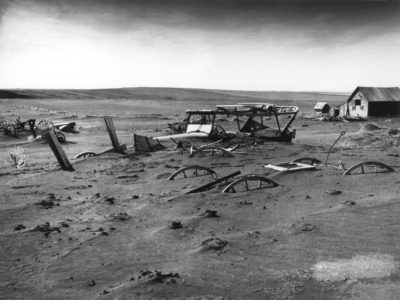
A buried barn lot in South Dakota at the tiptop of the Grit Basin in 1936. Wikimedia Eatables
Just the catastrophe spurred innovation, likewise. In the midst of the Dust Bowl, the government acted apace to establish the Soil Conservation Service, which helped promote more sustainable techniques like no-till agriculture and cover cropping, which reduce the amount of exposed soil. Many of the heartland's industrial-scale farming operations, nonetheless, did non adopt these practices, though in recent years no-till agriculture has become more widespread.
Since the 1940s, many farmers on the Great Plains also have extensively irrigated their crops, allowing them to conditions dry periods and further preventing topsoil erosion. Simply that reliance on irrigation has left the Great Plains open to new dangers. The Ogallala Aquifer — which makes up most of the High Plains Aquifer System and supplies the h2o for 30 to 46 percent of irrigated country in some Great Plains states — has been steadily overdrawn in recent decades; by some estimates, the Ogallala Aquifer could exist lxx per centum depleted within 50 years.
"At that place comes a signal where if you're not replenishing those resources like aquifers, then all you lot need is the side by side minor drought to come forth, and if you don't answer, then you run the risk of another Dust Bowl-similar event," says Tim Cowan, a senior research beau at the University of Southern Queensland who studies the effects of climate modify on precipitation and heatwaves.
Rut and drought are intimately linked, significant that worsening heatwaves mean more droughts and vice versa. That one-ii punch has many scientists concerned. "Dry out soils have this exacerbating upshot," says Wim Thiery, a climate scientist at the University of Brussels. "There is this positive feedback where dry soils lead to more warmth."
When the soil contains a lot of moisture, incoming energy from the sun gets absorbed by the water every bit information technology turns from a liquid into a gas. But when the soil contains little water, that energy is converted directly into heat. The result is that droughts atomic number 82 to more severe heatwaves, and those heatwaves in turn pb to drier conditions.
Corn and soy crop yields would decline by twoscore percent in a modern Grit Basin scenario.
Information shows that both drought and oestrus are becoming more than common — and perchance increasing the feedback effects between them. In a recent study in Nature, Cowan and his coauthors found that greenhouse gas emissions accept made a menses of Dust Bowl-similar heatwaves more than two-and-a-one-half times more than likely compared to the 1930s.
Ben Cook, a climate scientist at the NASA Goddard Institute for Space Studies, says the aforementioned goes for drought. "What we're seeing in a lot of regions is this kind of amplified evaporation result that's making it … easier to go into drought, a little bit harder to get out of drought, and making the droughts themselves a bit more intense than they would have been in a colder world."
Meanwhile, agronomics continues to thrive in the Midwest and Great Plains. The combined regions are top producers of crops like corn, wheat, and soybeans, also as livestock. That level of agricultural intensity, paired with increasingly hotter weather, raises the stakes for the United states should another historic drought occur.
One paper in 2016 relied on figurer simulations to model the effects of Dust Bowl conditions on mod agriculture. Corn and soy crop yields would decline past around forty pct, the authors gauge, and wheat yields would drop 30 percent. And every one degree Celsius (1.8 F) increment in temperature would cause the effects to worsen by 25 percent.
In a world where drought and heatwaves become routine, the two might combine to tip the country into a situation where agriculture becomes increasingly threatened, with profound impacts on U.Due south. food supplies.
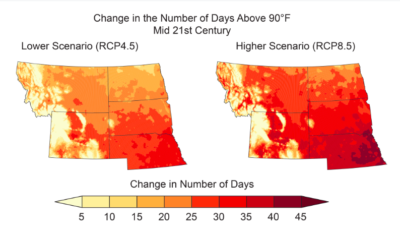
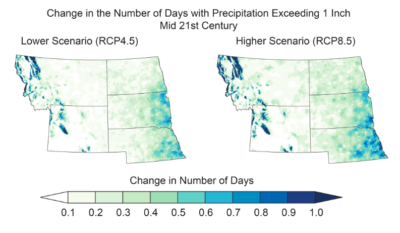
Projected changes are shown for the annual number of very hot days and heavy precipitation events in the mid-21st century. GlobalChange.gov
The United State got a recent taste of Grit Bowl-similar conditions. In 2012, the country experienced one of its worst droughts on record, along with a sizzling heatwave. La Niña conditions in the Pacific Bounding main, combined with the lingering effects of a dry out 2011, resulted in the driest summer in the U.S. since 1988. By July, nearly 2-thirds of the land was in drought conditions, co-ordinate to the U.S. Drought Monitor. Meanwhile, July 2012 was the second-hottest month on record at the time.
The effects on the nation'south farmers were substantial. Estimates put agronomical losses at around $xxx billion, and corn yields declined by 26 percent. But fifty-fifty though the 2012 drought was similar in character to the Grit Basin, billowing dust storms and wholesale agricultural collapse were absent-minded. Similarly, a astringent drought in the 1950s also failed to kick off some other Dust Basin.
"Nosotros've had bad droughts in the Key Plains since the Dust Bowl, just we haven't had the aforementioned level of country degradation and dust storm activity," Melt says. "And part of the reason for that is because our land use practices have changed."
For the time beingness in the Great Plains, irrigation allows farmers to weather even astringent droughts by drawing on water stored in underground aquifers. Just the overuse of the High Plains Aquifer Organisation, especially the Ogalalla Aquifer, is taxing the region'southward groundwater supplies. Since 1987, the U.Due south. Geological Survey (USGS) has been gathering yearly information on water levels in the High Plains Aquifer past monitoring thousands of wells.
Though changes vary across the region, the overall picture show is one of persistent decline, says Virginia McGuire, a hydrologist with the USGS who'southward been monitoring the aquifer for more than two decades. The volume of water in the aquifer in 2015 had fallen by 273.ii million acre-feet since irrigation began in the 1940s, according to a USGS written report she authored. A map in the report shows red blotches spread across Texas, Oklahoma, and Colorado, revealing stark declines in the amount of h2o infusing the soil. Water levels in some places are less than half of what they were a century ago, McGuire says.
"If that trend doesn't change, at some signal at that place'south going to have to be a reckoning," she says.
"You will reach the indicate at which there is no more water coming from the wells," says one skilful.
So much irrigation is taking place on the Bully Plains and in other global agricultural zones that the added water is actually cooling regional temperatures. In a 2020 newspaper in Nature Communications, Thiery and his colleagues compared average temperatures in heavily irrigated regions to those in the residuum of the world. "We establish that irrigation has a pretty pronounced cooling issue," he says. Regions that were irrigated warmed on average by 0.viii C (1.5 F) less on hot days than the rest of the world, they establish. But the cooling effect of large-scale irrigation is ultimately unsustainable.
"We are putting massive pressure level on our groundwater resources by irrigating," Thiery says. "At some point you will reach the point at which there is no more water coming from the wells."
H2o managers and farmers are already making changes to reduce water use, such as irrigating simply half of their fields, or using multiple smaller wells to increase water yields from parched groundwater reserves, according to McGuire. Merely depleted aquifers take a long fourth dimension to recharge, especially in areas like the southern Plains, where the h2o tabular array is far below the surface. Meanwhile, dry years proceed to stress the aquifer. During the 3-year period between 2011 and 2013, the aquifer lost nearly as much water as it did between 1980 and 1995.
In 2012, says Melt, "the organisation was resilient enough to deal with a single year of really bad drought in the key U.S. Now, if that 2012 drought had lasted three, four, or five years, would our organization take been able to handle that? That I don't know."
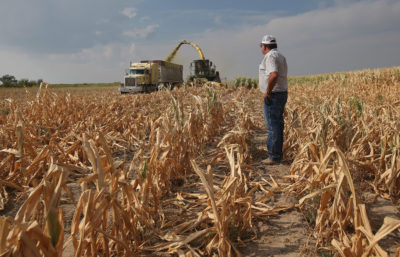
Eastern Colorado farmer Jay Sneller watches the mowing of his drought-ravaged corn crop during the drought of 2012. John Moore / Getty Images
A fundamental reason for the resilience of U.S. agronomics is the government'due south ability to provide aid to farmers when times are tough, Melt says. But climate change is affecting the entire world, with hotter, drier conditions predicted to increase in regions — such equally Southern asia and Eastward Africa — that may take little ability to cope with more than extreme weather. In the Indian country of Punjab, where more than 80 percent of the country is used for agriculture, h2o tables are dropping chop-chop. A 2019 heatwave in India saw temperatures climb higher up 120 F, while water shortages led to fierce clashes.
A European drought has also strained groundwater resources beyond much of the continent. Data from NASA'southward GRACE-FO satellite from June 2020 revealed dangerously dry soils in Germany, Poland, the Czech republic, Ukraine, and parts of Russian federation. Similarly, a record-setting drought in Commonwealth of australia from 2017-2019 battered farmers, with extreme heat too sweeping across the state. Even if nations — particularly developing nations — adopt more sustainable irrigation and agricultural practices, a rapidly changing climate means they could still confront crop failures that imperil food supplies.
The Dust Bowl is a uniquely American touchstone, a story of hardship and eventual triumph that has come to define both our land's historical narrative and physical reality. But in a world where climate weather grow steadily more extreme, that unparalleled disaster could become far more common.
Source: https://e360.yale.edu/features/as-the-climate-warms-could-the-u.s.-face-another-dust-bowl

Post a Comment for "Can the Dust Bowl Happen Again"